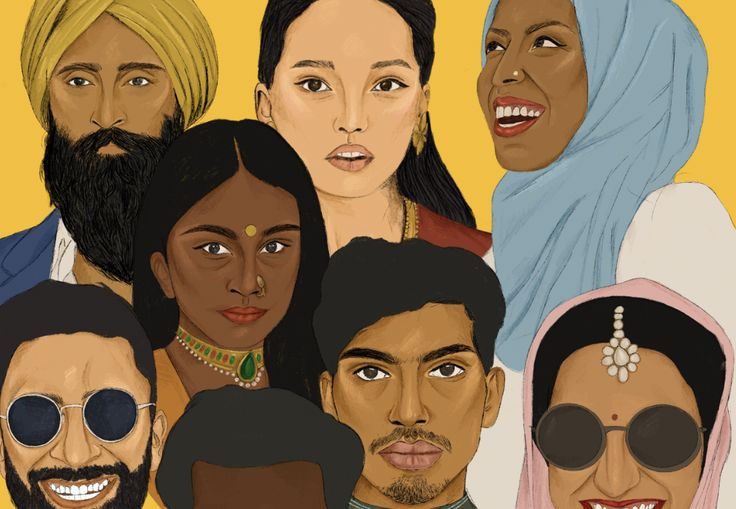
Asian: Am I More Than Just 5 Letters and a Box?
- Dec 16, 2025
- 5 min read

“Wait, you’re Asian?” That’s what someone asked me the other day. “Ohhhh yeah. I forgot,” is what followed.
At Dalton, we talk a big game about diversity, equity, and inclusion. But sometimes, despite the good intentions behind that talk, that same “big game” can miss key points—or peoples. We talk about including everyone regardless of race—Asian people, Black people, White people, Latinx people. But what we don’t talk about is everyone within those words. What we don’t talk about are the minorities within the minorities.
Take the word Asian. It sounds simple enough—it’s just 5 letters long. But in those 5 letters are the 4.561 billion people who live in Asia, and that’s still excluding everyone of Asian descent located in other parts of the world. In today’s world, words like “Asian” carry so much meaning.
However, the fact of the matter is that it’s nearly impossible for 5 letters to fully cover, fully represent, and fully bring justice to more than half of the world’s population. Instead, what tends to happen is that the meaning of the word begins to change. Because regardless of whatever you may think of when you hear the word “Asian,” whether it be a certain country, a certain ethnic group, or a certain stereotype, at the end of the day, you only have one first thought. And the more this first thought appears, the more used to it we become. And just like that, the way we define a word in both our minds and our society begins to change. So no matter how hard we may try, when we think of the word “Asian” or “Asia” with its 48 countries and incredibly diverse cultures, it becomes almost impossible to not mentally re-define the word. And when definitions don’t align and people begin to be forgotten, the more it can start to hurt. And the harder it becomes to remember that even though there are bigger and smaller countries, at the end of the day no one is any less or any more Asian than anyone else.
I can speak, firsthand, to the disconnect I feel to my own heritage and ethnicity because of these 5 letters. And although I cannot speak for everyone, I know that it is not hard for language and definitions surrounding you to start to become your own. When this begins to happen, you’re left to sit and wonder who you are, where you are from, and where you fit in a word with a definition that does not include you.
Due to what the stereotypical image of an Asian is, it is not a rare sight for one of South Asian descent to be mistaken for an entirely different race. As Mira Gulati ‘26 says, “People’s presumption that I’m Latina is really hurtful to me because it makes me feel as if I’m not worthy of identifying as Asian just because I don’t look like their idea of what an Asian should look like. It also makes me feel as if I’m a different species that no one’s ever heard of and that it is constantly my job to educate people about the fact that India exists.” I can second this statement.
Further, I know that it becomes harder and harder every time someone forgets you’re Asian or asks the question, “Wait you’re Asian?” simply because the definition of a 5 letter word has changed. But, being Asian is not just being from East Asia or just being from South Asia or just being from Central Asia. In fact, the technical definition of Asia stretches all the way from Cyprus to Japan. Being Asian means identifying as Asian, regardless of where in Asia you may be from. Being Asian means being from countries like China, Japan, Mongolia, and North and South Korea, but being Asian also means being from countries like Turkmenistan, Kazakhstan, Uzbekistan, and Kyrgyzstan. Being Asian means being from any one of Asia’s 48 countries, and, most importantly, being Asian means being so much more than just 5 letters and one box on a standard list.
For a large portion of my recent life, this misconception—this disconnect—has found a home in the corner of my mind. Not only have I been left wondering how such a thing could happen on the scale it has, but I have also been left wondering where I stand. If I am not Asian, what am I? I am certainly not a stereotypical American, and I am certainly not nothing. Or am I? Am I simply a person who exists but whose identity has been forgotten and tossed aside by a society in which making a generalization is easier and more efficient than taking the time to understand?
And so, this is the danger of the umbrella term. While generalizations can at times be helpful, they can also be incredibly hurtful. Those behind generalizations often create them for their own sake--for the sake of simplicity. However, the hard truth is that simplicity is often equivalent to duplicity in what is left out, in what is forgotten through simplification.
Prior to writing this article, I had largely focused on how the misconception of who is Asian and who is not affected people of South Asian origin—people like me. This meant I largely focused on the western part of the continent, and as such I had only really seen that this disconnect was present there. However, through this process, I have come to discover that the same disconnect that I feel is also present in Eastern Asia, as Angelina Chu ’26 states: “Until half a year ago, I thought that I was East Asian and not Southeast Asian because I was mistaken for a Chinese person so many times.” Due to Asia’s sheer scale, it should have come as no surprise to me that this was an issue present across the continent and not just in western areas. Yet, it did. I was shocked that someone from a more eastern part of the continent had been mistaken so many times that a disconnect had formed--I couldn’t conceptualize that someone who looked more “Asian” than I would have this issue.
While I would give nearly anything to snap my fingers and solve this issue, I cannot. Things like this cannot be fixed so easily, if fixable at all. However, there are things we can begin to do to steer ourselves in the right direction. For one, we could ask more and assume less. Instead of assuming someone is a certain race, we can ask. Instead of assuming what someone is or would like to be called, we can ask.
And if that isn’t applicable to your situation, or you still aren’t sure, at the very least try moving away from umbrella terms like Asian. Instead, use more geographic terms like East, Central, South, Southeast, and Western Asian. While this does not completely fix the issue, while this still doesn’t bring everyone all the justice they deserve, we have to start somewhere. We must begin the trek down the road of restoration, no matter how daunting, and we must begin to return the identities of those who have been forgotten and disregarded. If we don’t, am I nothing more than just 5 letters and a box?