“Don’t Let Her Go Alone”
- Dec 16, 2025
- 8 min read
Trigger Warning: This article discusses the topic of rape, sexual assault, and violence against women, which some readers may find triggering.
Over 65 years ago, a 10-year-old girl went out to play. She never came home. Her name was Mampta Banik, and she was my grandmother’s cousin-sister. The family made calls and visited relatives, asking if they had seen Mampta, but no one had. They went to the police to file a report but were denied, the police citing the need for at least a day to have passed before one could be accepted. Two days later, there were still no leads. Until, on the third day after she went missing, Mampta was found in the river, covered in stab wounds. My family still doesn’t know the full story.
From then on, everyone was on edge. My grandmother was the only girl in the family, and everyone wanted to protect her. My great-great-grandfather would frequently say things like, “Don’t let her go alone.” If she were a few minutes late coming back from work, the entire family would begin to worry. Was she scared? Did she wonder if the same fate that met her cousin would meet her? Maybe the fear became so much a part of her daily life that she no longer realized it was there, its heart beating alongside hers. My grandmother was always “very careful” and “didn’t go outside in the dark.”
This is the reality that so many women and girls in India face. On average, a woman in India is raped every 18 minutes. However, this disturbing figure is likely inaccurate. Roughly 99.1% of instances of sexual violence go unreported, whether it is out of fear of retaliation, shame, or the fact that the perpetrator is also the woman’s husband.
On August 4, 2024, a junior doctor at R. G. Kar Medical Hospital in Kolkata was brutally raped and subsequently murdered. After completing a lengthy 36-hour shift, she had fallen asleep in a seminar room on campus, where her body was later found, half-naked, on the podium. Blood oozed from her eyes and mouth, and signs of torture and beating were evident. A suspect, who was reportedly a volunteer at the hospital, has been taken into custody. He is said to have previously evaded capture for other offenses against women.
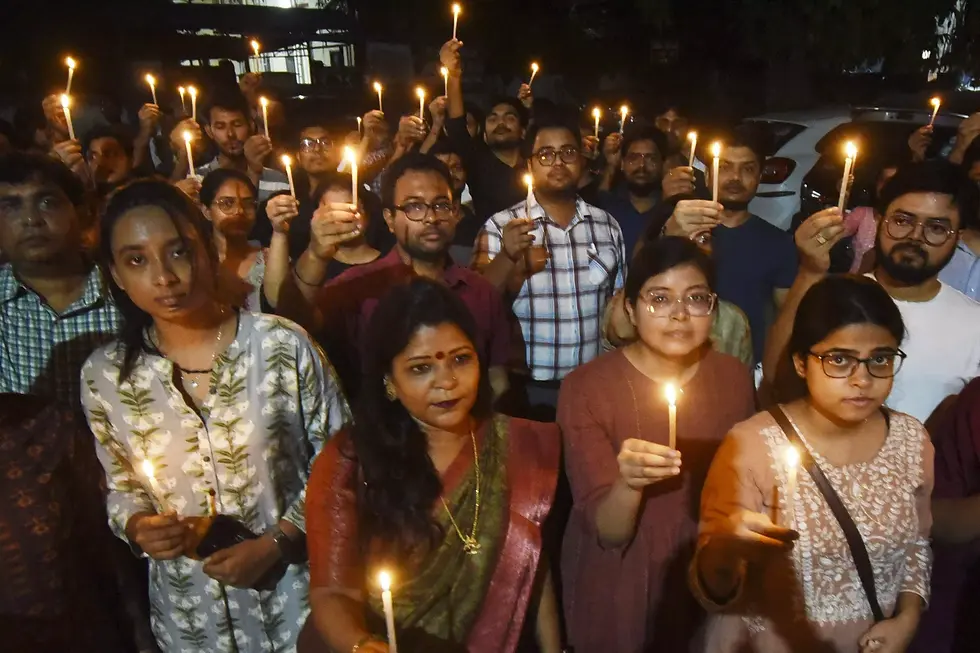
Under the rallying cry of “Reclaim the Night” which was pioneered by the Leeds Revolutionary Feminist Group in London in the late 1970s, the rape inspired protests across India. While the largest protests have taken place in Kolkata — the site of the attack — smaller movements have also occurred in key Indian cities like Mumbai, Delhi, and Goa. Women, irrespective of age, marched through the rain alongside families with children and even men, who are a key demographic in the fight to truly enact change.
Their presence at these rallies highlights the breadth of the issue. It is no longer only a woman’s fight; instead, it has also become that of her brother, husband, father, and uncle. Rape and sexual assault have become so prevalent that men, who are the most frequent offenders, have begun to demand justice and protection for women. The demand is not only on behalf of those whom they care for but also for those who have been wronged, like the doctor at R. G. Kar. Their support is crucial given the greater agency and respect they frequently have in Indian society; with their help, perhaps real progress is possible. Further, ensuring men receive education and the burden is shifted off of women and to men to exercise self-control and respect is key.
Nationwide, junior doctors have stopped services in state hospitals, demanding greater safety measures be implemented. As their younger counterparts demand freedom and equity to “reclaim the night,” senior doctors have taken on larger patient loads in solidarity.
The case has also sparked outcry on social media, generating global attention. One Instagram user with over 100 thousand followers, @tiptopped, described her medical training in Kolkata: “...Before dozing off in the space we used to rest, I obsessively checked behind doors, under the bed, the toilet. I do not have enough words to explain how unsafe the environment was.” Between dimly lit corridors and a lack of security, she often “prayed that [she] encounter[ed] ghosts rather than humans!” She and her colleagues also faced sexual harassment, shaming, and bullying from patients, attendants, and even teachers as well as fellow students.
India’s prime minister, Narendra Modi, did not directly address the rape. Instead, he called for increased accountability for perpetrators and for greater media interest in the punishments they receive. However, how does his statement even begin to combat the societal structures that have made such inhuman actions commonplace? How is accountability possible when families are discouraged from reporting, and police cremate bodies without familial consent, making investigations more difficult? How is that possible when innumerable women are unable to receive the justice they deserve due to the shackles of fear they are forced to live with?
This is not the first time protests have erupted following a sexual attack. Gaining mass-media coverage, brutal rape cases and protests have become cyclic. Despite this, no changes large enough to truly protect women have been made. In 2012, a woman in New Delhi was brutally gang raped, leading to her death. Protests ensued. Some laws were changed, and the definition of violence against women expanded. Still, incidents of rape persisted. Yes, it is impossible to completely eradicate the problem. However, no significant progress has been made besides perhaps the outspokenness with which women respond to such attacks and advocate for themselves. The number of reported rapes in 2022 was nearly 6,600 higher than those reported in 2012. While the legal changes were essential, they are still not enough. More must be done to address and educate men on their role and to dismember the harmful cultural stereotypes and beliefs that frequently disadvantage women.
Authors have even written novels to shed greater light on the issue. In Atharva Pandit’s 2023 Hurda, three young girls disappear and are later found dead and likely raped at the bottom of a well. The corrupt police do little to help, and the case ultimately goes unsolved. The novel is based on a true story — one that is too true for many women and girls in the nation.
Perhaps the mistreatment of women has become so normalized due to the deeply patriarchal values and culture instilled deep within India’s roots. There, as well as around the globe, women have long been seen as the property of men: the responsibility of the father until they are married and become a ward of the husband. In an over 1,000-year-old now-outlawed practice called sati, widows sacrificed themselves atop their recently deceased husband’s funeral pyre. A sign of ultimate devotion to their husband, women would often dress in their bridal attire. Seen as an opportunity to become chaste once again, thereby gaining good karma, it was an honorable death — one that was favored by and large to the widow remaining alive. Without their husbands, women often had no other means of financial support; in order to avoid becoming a burden on society, they were often pressured or forced into sati. Given that sati was primarily a Hindu practice and that nearly 80% of the nation remains Hindu today, many of the values that drove it still remain present.
Another driving factor is also notions of female modesty and dress. For instance, in the southern city of Chennai where temperatures frequently exceed 90 degrees Fahrenheit, women don ankle-length pants and tops with half-sleeves. It should come as no surprise that this style of dress is not the most suited to warm climates. Meanwhile, men are frequently seen wearing short sleeves and even tank tops, leaving their shoulders — which women are expected to cover — exposed and uncovered. A similar notion exists throughout the nation, though in some less conservative cities, like Mumbai and Delhi, women may be seen wearing styles more similar to what may be worn in the West. All in all, the burden to remain “protected” lies on the women as opposed to educating and emphasizing male self-control.
When I was planning to visit India this past summer, I put off packing as long as I could. I had no desire to look at all my colorful tops, all the summer dresses that would have been perfect for the heat. I knew I couldn’t take them. Or, rather, I knew I couldn’t wear them. I may pack them, my shorts and skirts, my spaghetti-strapped dresses, but I would never let myself wear them out, let myself stand out that much in a nation where as much of me being covered was expected. And that’s not to mention all the sideways glances from women I would receive, nor the looks men would likely give me. Home, I look in my closet, realizing how lucky I am.
From behind the protective windows of the AC cars we rode in, I looked out at the roads, at the men riding in open air trucks. Maybe it was distaste at my relative comfort, envy of my well-standing, or maybe it was something else. The slight, brief leering look in their eyes coupled with the knowledge of the long history of rape and sexual violence in the nation that is my homeland was enough to send shivers down my spine. What I experienced, though, was a mere discomfort compared to the atrocities others have endured.
Maybe the reason I felt so uncomfortable was because disappearance was easy. With India’s many cities, small alleys and winding streets, busy markets with haggling salesmen, and sheer amount of people, it would be easy to be lost and never found. It would be easy to be dragged somewhere I didn’t not belong, for my voice to be drowned out by the honks of autos and traffic, for people to ignore my plight as they focus their energy on braving their own daily struggles. The ease with which this could happen is the ease with which it does for women across the nation every single day.
A tragedy is not a strong enough word for what has occurred in Kolkata. In fact, it is simply incorrect — the word does not do the 31-year old woman whose life was taken from her on August 4th justice. What has occurred is nothing less than a horrific display of inhumanity and a lack of respect. However, this is the cold reality for so many Indian women every day. It has become a part of everyday life. The fear and pain has become so ingrained that women no longer know it is there.
Sitting in our ivory towers, it is easy to think of India as a place where this happens while we are safe without it at home. We pride ourselves on thinking we are better; thinking, “that would never happen here, no, not in these United States.” However, we are incorrect. According to Statista, India’s total number of reported rape cases was 31,516 in 2022. For the same year in the US, there were 133,294 reported cases of rape. In the US, just as in India, the number of unreported cases of rape is high: 63%. India is home to over a billion people, while the US holds just about 333 million.
These issues are not limited to the US and India, instead existing across the globe. They do not discriminate, paying no regard to borders, race, creed, and class. Turning a blind eye and believing they do not exist in our own nation and are only present in those which are “less developed,” that rape and violence against women is not a problem and a reality that millions of women face every day — that, that is the real tragedy.